Family day care vs long day care: which suits your child better
By Marcus Beck · Updated 2026-07-15
Families often default to whichever care type they’ve heard of first, but family day care and long day care are genuinely different models, not just different price points. Knowing what actually changes between them makes it easier to pick the one that fits your child and your routine, rather than simply the one with a vacancy.
The core differences
| Family day care | Long day care | |
|---|---|---|
| Setting | A registered educator’s own home | A purpose-built centre |
| Group size | Small, usually a handful of children of mixed ages | Larger, split into age-based rooms |
| Routine | More flexible, closer to a home environment | More structured, program-based across the day |
| Hours | Often more flexible on start and finish times | Set opening hours, usually full business day |
| Educator continuity | Same educator most days | Room-based staffing, though many centres aim for a consistent primary carer |
| Curriculum | Less formal, play and routine-based | Structured educational program, especially in the pre-kindy year |
Both models are regulated under the same national quality framework, so neither is inherently “safer” or more compliant than the other. The differences are about environment and structure, not oversight.
When family day care tends to fit better
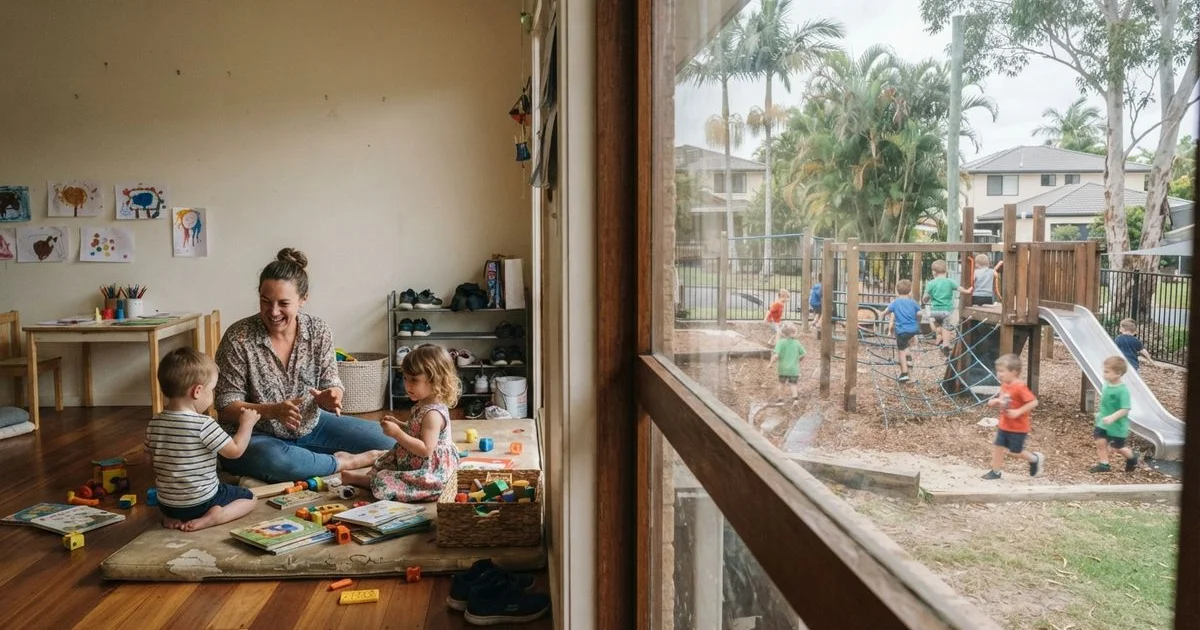
Family day care often suits families who want a smaller, more home-like setting, particularly for babies and younger toddlers who benefit from a quieter environment and a consistent, familiar adult. It also tends to offer more flexibility around start and finish times, which matters for parents with shift work or non-standard hours. Mixed-age groups mean siblings can sometimes attend together, which some families prefer.
When long day care tends to fit better
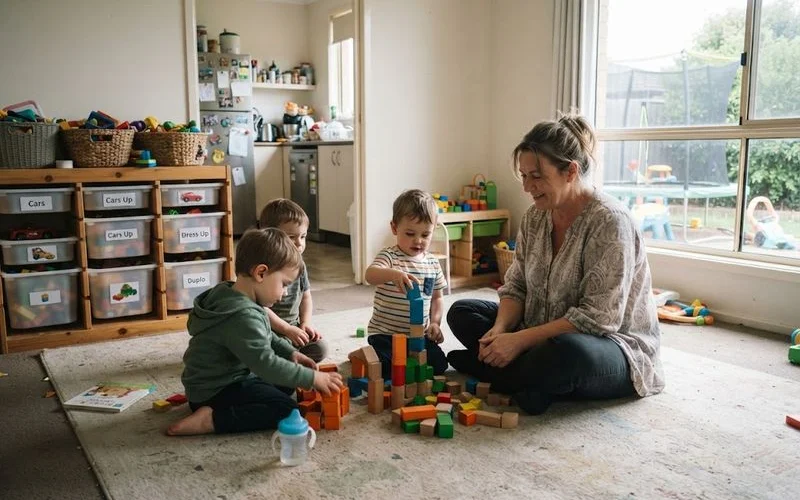
Long day care usually suits families who want a more structured program, particularly once a child is approaching kindergarten age and benefits from group-based learning, a wider range of educators and specialists, and a purpose-built outdoor and indoor environment. Centres also tend to have more built-in backup if your regular educator is sick, since a room has multiple staff rather than a single person.
Questions worth asking either way
Regardless of which model you’re leaning toward, the same core questions apply: what does a typical day actually look like, how do they communicate with parents, what’s their approach to settling a new child in, and how long have current staff or the educator been in the role. A long day care centre with high turnover can end up feeling less consistent than a well-established family day care educator, so don’t assume the model alone answers the consistency question.
What families actually report noticing
Across reviews of Gold Coast providers, the strongest recurring praise for both models centres on the same things: educators who know a child individually, clear day-to-day communication, and consistency over time. Families rarely mention the model itself (family day care versus long day care) as the deciding factor in how happy they are, they mention the specific educator or room team. That’s a useful reminder that the provider you choose within a model often matters more than the model you pick.
Where the models do diverge in feedback is around backup cover. Long day care centres usually have another educator to step in if your child’s regular carer is away, while a family day care arrangement can mean a day with no care at all if your educator is unwell, unless they have an established backup arrangement with another registered educator. If reliable daily cover matters more to you than a smaller, closer environment, weigh that trade-off directly with any family day care educator you’re considering.
Making the call
If you’re still unsure, it’s worth visiting one of each rather than deciding from a website alone. A quick visit tends to make the difference between the two models obvious in a way that a comparison table can’t fully capture, particularly around noise level, pace, and how staff interact with the children already there.
Our methodology explains how we score both family day care and long day care providers on the Gold Coast using the same weighting, so you can compare across models rather than only within one. Start from the Gold Coast Child Care Guide home page to browse rated options either way.
Common questions
- Is family day care cheaper than long day care?
- It often sits a little lower on fees since it runs from a home rather than a purpose-built centre, but the gap varies by educator and location, so it's worth comparing actual quotes rather than assuming.
- Does the Child Care Subsidy apply to family day care?
- Yes, as long as the educator operates under an approved family day care scheme. Confirm this directly, since an informal home-based arrangement outside a registered scheme won't qualify.
- Can I switch between the two if it's not working out?
- Yes, families move between family day care and long day care fairly often as a child's needs change, though it's worth allowing a settling-in period at the new service before deciding it isn't working.
- Which one is better for a child who needs more one-on-one attention?
- Family day care's smaller group size generally gives more individual attention by default, though a long day care room with strong staff continuity and lower turnover can offer this too. Ask about actual ratios and staff tenure rather than assuming based on the model alone.